

Conducted between 2016 and 2023, the DVDC National Project (Pavement Service Life) brought together 40 partners around a major challenge: gaining a better understanding of pavement ageing, assessing remaining service life and optimising maintenance strategies. Beyond its scientific and operational results, the project helped identify new research questions and open up new perspectives for infrastructure as a whole.
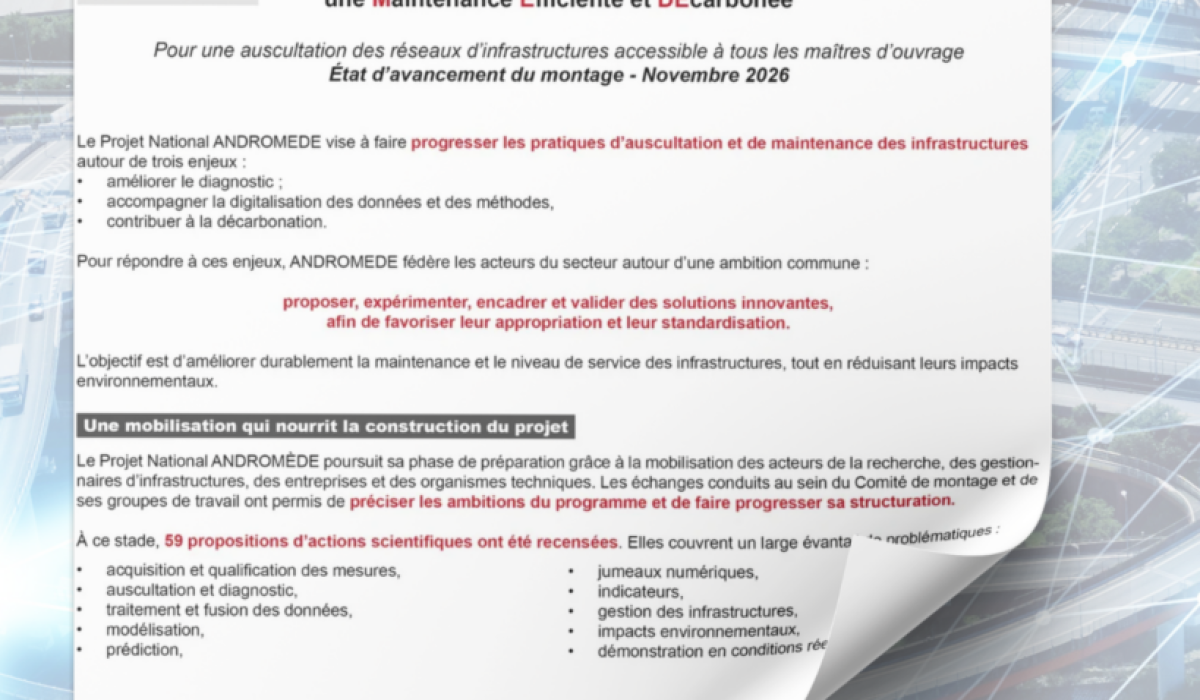
This momentum gave rise to the ANDROMEDE project, which aims to broaden the scope of the work undertaken and advance infrastructure network inspection and maintenance practices.
DVDC: scientific and operational progress
Coordinated by IREX between 2016 and 2023, the DVDC National Project brought together 40 partners representing the road infrastructure sector: network owners and operators, public authorities, research organisations, engineering consultancies, road construction companies and industrial partners.
Its work focused on assessing pavement service life at three complementary scales:
- At road network level, to better characterise the condition of road sections and help infrastructure managers prioritise maintenance interventions.
- At pavement structure level, to understand and model deterioration mechanisms, particularly cracking and interlayer debonding.
- At material level, to study material behaviour, ageing and changes over time under the effects of traffic loading and climatic conditions.
This research led to numerous outcomes, including pavement condition assessment methods, comparative testing of inspection equipment, proposals for surface condition descriptors, modelling work and recommendations for updating pavement design methods.
The project’s results summary, available in French, English and Spanish, brings together these contributions and helps make them accessible to industry stakeholders.
New research questions leading to ANDROMEDE
The work carried out within DVDC also highlighted the importance of having reliable and comparable data, appropriate inspection methods and tools to make better use of the information collected on infrastructure networks.
Discussions between partners and the research opportunities identified at the end of the project helped bring new research needs to the fore. A broader ambition gradually took shape: to move beyond the specific scope of road pavements and address the challenges of inspection, diagnosis and maintenance across different infrastructure networks.
It was within this context that the development of the ANDROMEDE National Project began: Inspection, Standardisation, Digitalisation of Infrastructure Networks, Interoperability for Efficient and Decarbonised Maintenance.
Its ambition is to make infrastructure network inspection accessible to all infrastructure owners and operators, while advancing practices around three complementary challenges:
- improving infrastructure diagnosis and knowledge of asset condition;
- supporting the digitalisation of data and methods, as well as their interoperability;
- contributing to more efficient and decarbonised maintenance.
ANDROMEDE: a new collaborative initiative taking shape
The development of ANDROMEDE is already bringing together a broad range of industry stakeholders: 33 organisations and groups have contributed to the discussions, and 15 organisations are represented on the Project Steering Committee.
The initial scientific proposals demonstrate the interest generated by the project: 59 research proposals have been submitted, resulting in 88 assignments to working groups. Of these, 20 proposals, or 34%, involve several working groups, highlighting the cross-disciplinary nature of the topics being addressed.
The scientific structure is also evolving to ensure better coordination between research themes. The six working groups initially envisaged are being reorganised into five, including the merger of the former Working Groups 2 and 3 around four main areas:
- data acquisition and qualification;
- data processing and fusion, including the contribution of artificial intelligence;
- diagnosis, modelling and prediction;
- representation, reference systems and indicators.
The project has also received initial support from FEREC under its 2026 call for projects, for two research initiatives: a comparative analysis of pavement condition assessment methods, and an examination of existing linear geographic reference systems and possible developments.
A shared ambition: better knowledge for better maintenance
From DVDC to ANDROMEDE, a common objective emerges: improving knowledge of infrastructure condition to help asset owners and operators develop appropriate maintenance strategies, preserve their assets and control their economic and environmental impacts.
While DVDC deepened our understanding of pavement behaviour and ageing, ANDROMEDE aims to build on this momentum on a broader scale, bringing together infrastructure inspection, data, diagnostic methods and interoperability.
The feasibility and project development study is scheduled for submission in December 2026. The official launch of the National Project is envisaged for the first quarter of 2027.
The collaborative momentum initiated through DVDC is therefore paving the way for a new phase of joint research, dedicated to improving infrastructure knowledge and supporting sustainable maintenance.